


GARDEN ROUTE NEWS - After seven years of invasive carp removal at Groenvlei Lake, the Invasive Fish Species Management NPC (IFSM) has withdrawn from the project.
The IFSM’s Johnny Snyman confirmed it had terminated its operations at the lake within the Goukamma Nature Reserve, citing a collapse in collaboration with Gift of the Givers (GOTG).
The IFSM started the programme in 2018 when it targeted invasive carp in Groenvlei and Island Lake. According to Snyman, it pioneered operational methods like the development of a bowfishing-based control approach under scientific guidance and exemption permits issued by conservation authorities.
During the Covid-19 pandemic in 2020, the project expanded to include a community feeding component, with the carp being distributed to soup kitchens and vulnerable households. This was the beginning of the IFSM’s collaboration with Gift of the Givers (GOTG).
Over seven years, the IFSM removed more than 40t of carp from the Garden Route. More than 20t was removed by bowfishing.
The IFSM says the split started in 2024, due to the GOTG withdrawing all financial support and equipment without notice and blocking the IFSM’s carp distribution through exclusive soup kitchen contracts. “The GOTG’s role was frequently misrepresented or misinterpreted in both traditional and social media outlets, often implying that they spearheaded the entire project.
The public record now shows that the very programme developed and operated by the IFSM has effectively been adopted and rebranded by another organisation, without acknowledgement of the foundational groundwork laid since 2018,” says Snyman.
“Has Groenvlei Lake become a mere funding platform for larger NGOs? Or will those now occupying the stage be able to match the IFSM’s professionalism, transparency and seven years of unmatched success in invasive carp management?”
The Gift of the Givers’ perspective
The GOTG says it became involved in the project to feed the hungry. According to the organisation’s Mario Ferreira, its role focused on the testing, processing and distribution of carp for human consumption, with laboratory testing conducted to meet Department of Health requirements.
Ferreira says the IFSM functioned as a service provider compensated for the fish supplied for distribution. “Their role was purely to provide fish to us for distribution. During the first month of service, the IFSM made use of its own bows to capture these fish, as well as a boat provided by CapeNature.
Over the months and years that followed, the GOTG acquired the necessary equipment (boat, nets, spears, etc.) for the IFSM to perform its duties at no charge to the IFSM,” he says.
As project co-ordinator, Ferreira was instructed to communicate with the IFSM, but says that some of its demands, like higher compensation, were unreasonable and not feasible.
“Under their demands, we could no longer make use of them as a service provider. At no stage was the GOTG tied to the IFSM as the sole provider of fish.
The IFSM stopped providing fish in October. CapeNature then agreed with us to proceed with the project without the IFSM due to the environmental impact on the lake caused by these invasive fish,” says Ferreira.
CapeNature’s position
CapeNature confirmed that it worked with both the IFSM and GOTG under separate memoranda of agreement and that no exclusive rights were granted to any single organisation.
According to it, the IFSM submitted regular data from 2018 to 2023, but no data were received for 2024. Since the IFSM’s withdrawal, the GOTG has reportedly submitted monthly data.
CapeNature also confirmed experimental methods trialled under its approval, including the limited use of bait attached to gill nets by the GOTG and earlier experiments by the IFSM using sound to influence carp behaviour. The project is still active.
Why carp control matters
The common carp (Cyprinus carpio) is listed as a category 1b invasive species under the National Environmental Management: Biodiversity Act. In protected areas such as Groenvlei, they must be actively controlled or eradicated due to their impact on water quality, aquatic vegetation and biodiversity.
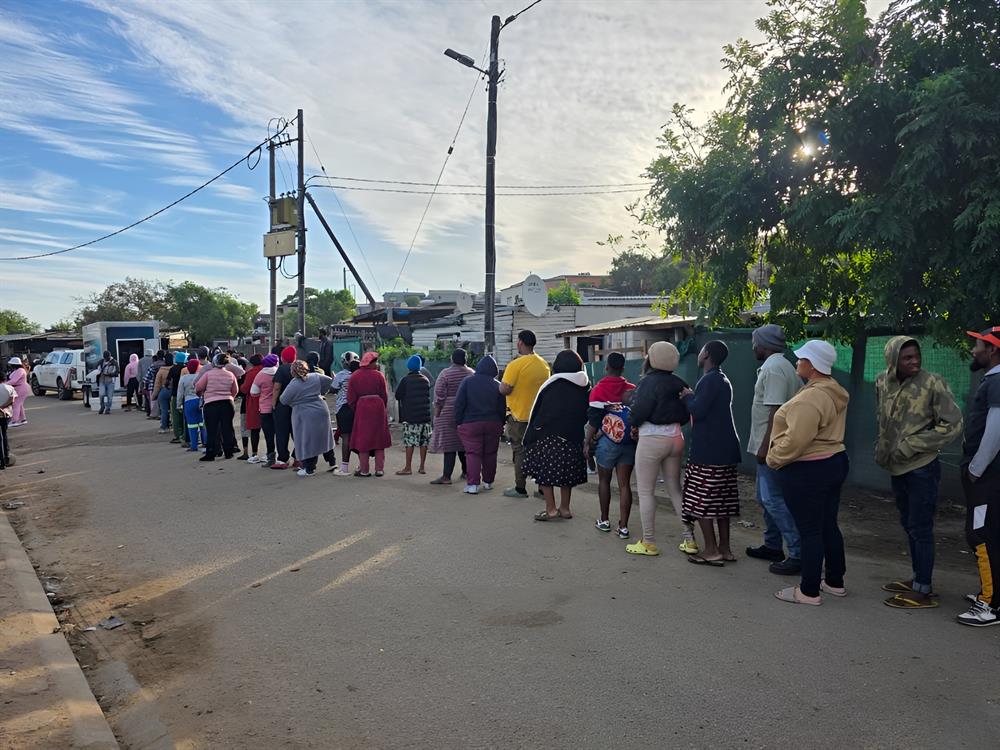 People wait in queues for their carp.
 Some of the carp that were removed from Groenvlei by the IFSM, with some of its team members in the background. Photo: IFSM’s Facebook pa
 Residents in the area happy to receive a carp for supper. Photo: Gift of the Givers
 Some garden fertiliser produced by IFSM using the carp.
‘We bring you the latest Garden Route, Hessequa, Karoo news’