

KNYSNA NEWS - If you got into your time machine and raced back millions of years to the Cretaceous Age, you might see dinosaurs doing the Dinosaur Stomp on the beach in what today is called the Knysna area.
In fact, you might stumble onto a dinosaur party.
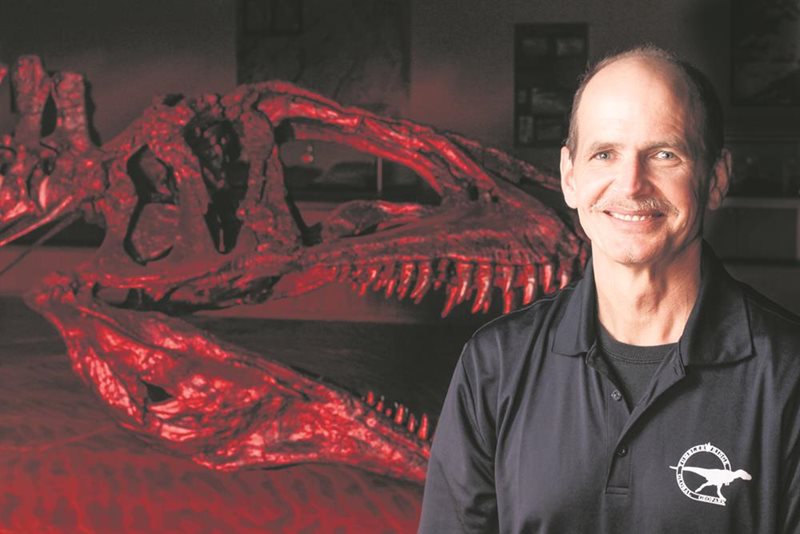
Newly released research by Dr Charles Helm and his research team, based at the African Centre for Coastal Palaeoscience at Nelson Mandela University, has revealed that more than two dozen dinosaur footprints have been found in the Knysna area.
An article on the find was published in The Conversation on 30 January.
"The tracks we found at Knysna are in the modern intertidal zone, where the high tide covers most of them twice a day," Helm told the Knysna Plett Herald in an email response from Canada.
"We were pleasantly surprised when Linda Helm, a member of our party who has a well-trained eye, told us in a state of excitement that she had found dinosaur tracks. It would be difficult to imagine a scene more different, 132 million years ago, from the spectacular coastline, magnificent estuary, and lots of development by humans that we encounter today.
"Back then, many dinosaurs would have been visible in the area, perhaps inhabiting tidal channels or point bars (river beaches). The vegetation would also have been very different from that of today," said Helm.
Brenton
The tracks were found in a tiny exposure of the Brenton Formation, no more than 40 metres in length and five metres in width, with cliffs rising to a maximum of five metres.
"To find dozens of tracks in this small area suggests a considerable dinosaur presence in the region during the Cretaceous Age," said Helm.
The tracks were made by theropods, possibly ornithopods (both these kinds of dinosaur were bipedal, ie, walking on two legs), and possibly sauropods (huge dinosaurs with very long necks and very long tails, which were quadrupedal, ie, walking on four legs). Theropods were meat eaters, while ornithopods and sauropods were plant eaters.
"In most cases, we have chosen not to 'over-interpret' which types of dinosaurs made which tracks, as they just aren't clear enough.
"Our research paper simply intends to document that dinosaur tracks of this age are relatively plentiful in the Brenton Formation. The fact that early Cretaceous dinosaur tracks have now been identified in both the Robberg Formation and the Brenton Formation in the Western Cape suggests that more may be found if a search is conducted in appropriate places," Helm said.
"There are a number of places in the Western Cape and Eastern Cape where suitable rock exposures occur. Systematic exploration of these rocks is now indicated, in the hope that in addition to finding more dinosaur bones, more dinosaur tracks will be identified,"
50 million years young
The newly discovered tracks are thought to be about 132 million years old, making them the youngest known dinosaur tracks in southern Africa (50 million years younger than the youngest tracks reported from the Karoo Basin).
They form only the second record of dinosaur tracks from the Cretaceous Period in South Africa, and the second record from the Western Cape province.
‘We bring you the latest Garden Route, Hessequa, Karoo news’