

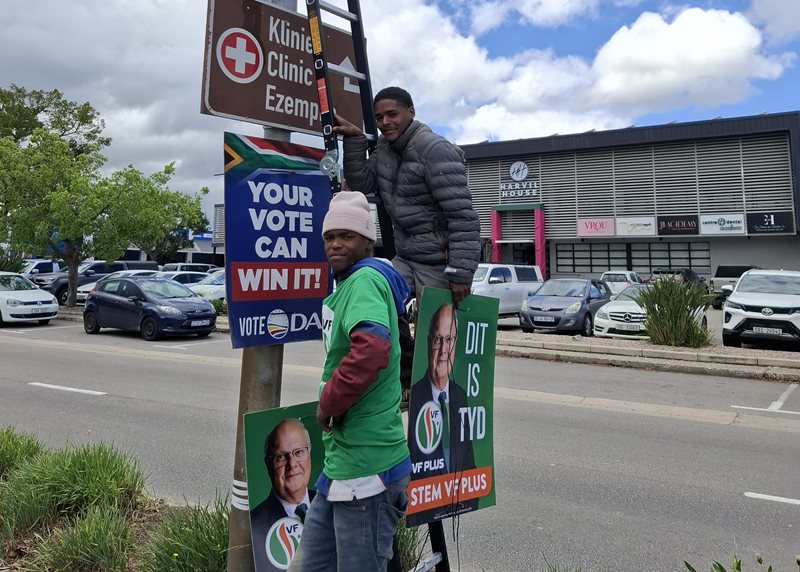
ELECTION NEWS - When voters across the Garden Route head to the polls on Wednesday 4 November, they will receive three ballot papers.
But what exactly are they voting for, and why are there three separate votes?
Unlike national and provincial elections, local government elections determine who will represent residents in their municipalities for the next five years.
For the voters in George, Mossel Bay, Knysna, Bitou, Oudtshoorn, Hessequa and Kannaland, this means making three separate choices: a ward councillor, a political party to serve on the local municipal council, and a political party to represent them on the district council.
Understanding the difference between these ballots can help voters make their choices with confidence.
Ballot 1: Your ward councillor
The first ballot is for the person you want to represent your ward on the local municipal council.
It contains the names of candidates contesting your particular ward, including candidates representing political parties and any independent candidates.
Unlike the other two ballots, this is a vote for an individual rather than simply a political party.
The candidate who receives the most votes in the ward is elected as its ward councillor.
Ward councillors represent residents in their communities and serve as a link between the public and the municipality on matters such as service delivery, infrastructure and local concerns.
Ballot 2: Your local municipality
The second ballot is the proportional representation (PR) ballot for your local municipal council.
Instead of voting for an individual, voters choose a political party.
The votes received by political parties help determine how many seats each party is allocated on the municipal council, alongside the ward election results.
This system allows political parties to gain representation in councils according to their electoral support, even if they do not win individual wards.
Ballot 3: Your district municipality
The third ballot is for the district municipal council.
In the Southern Cape, voters in the seven local municipalities that make up the Garden Route District Municipality will also vote for a political party to represent them at district level.
The district municipality has responsibilities that extend across municipal boundaries, including certain district-wide planning, co-ordination and municipal services.
As with the second ballot, voters choose a political party rather than an individual candidate.
Yellow, grey or green
Yellow ballot: Local council: Vote for a political party to represent you on your local municipal council.
Grey and white ballot: Ward councillor: Vote for an individual candidate, either representing a political party or standing as an independent, to represent your ward.
Green ballot: District council: Vote for a political party to represent you on the Garden Route District Council.
What about metropolitan areas?
Voters in metropolitan municipalities receive only two ballot papers: a yellow ballot to elect political party representatives to the metropolitan council, and a grey and white ballot to elect their ward councillor.
- Remember: You do not have to vote for the same political party on all your ballots. Each vote is a separate choice.
Heading to the polls? Here’s what to know
From making your choices to marking your ballots correctly, here’s what every voter needs to know before heading to the polls on 4 November.
Can you vote for different parties?
Yes. Voters are not required to support the same political party on all three ballots.
For example, a voter may choose a ward candidate from one political party, support another party on the local municipal ballot and choose a third party on the district ballot.
Each ballot is counted separately, and each vote serves a different purpose.
How to mark your ballot
Voters should make one clear cross (X) in the box next to their chosen candidate or political party on each ballot paper.
Avoid making additional marks, writing comments or signing the ballot, as this could result in a spoilt vote.
If you make a mistake, ask the presiding officer for a replacement ballot before placing the incorrect one in the ballot box.
Voting is confidential, and voters must mark their ballots in private.
What to remember on election day
Voting stations will be open from 07:00 to 21:00 on Wednesday 4 November, which has been declared a public holiday.
Voters must take their South African green barcoded ID book, smart ID card or valid temporary identity certificate.
Importantly, voters may only cast their ballots at the voting station where they are registered.
Residents who are unsure of their voting station can check their details through the Electoral Commission’s website, www.elections.org.za, or WhatsApp their ID number to 0600 88 0000.
‘We bring you the latest Garden Route, Hessequa, Karoo news’