

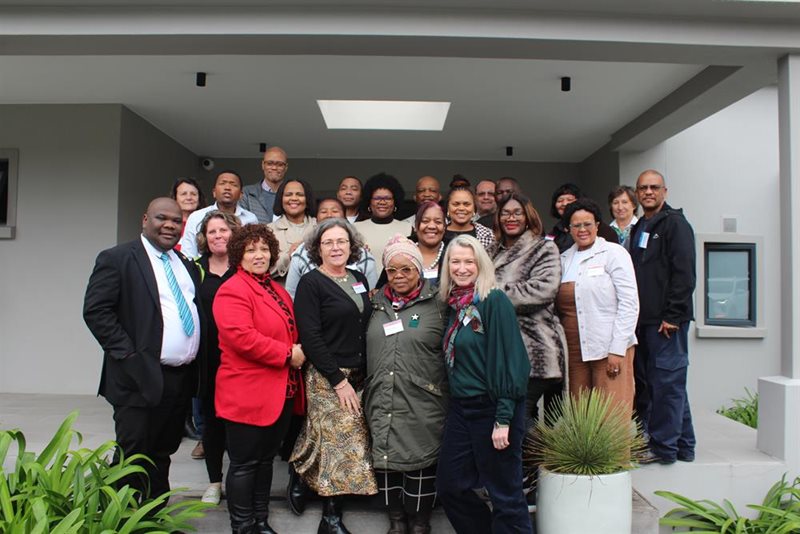
KNYSNA NEWS - In collaboration with the Knysna Municipality, the Knysna Education Trust (Ket) hosted a municipal early childhood development (ECD) planning day at the Knysna Hollow Country Estate on 17 September to narrow the gap between ECD facilities across the greater Knysna.
The engagement focused on strengthening co-operation and practical support for about 89 ECD facilities serving 3 000 children across the greater Knysna. Through this partnership, the municipality aims to address barriers facing ECD centres and support safe, accessible and quality early learning opportunities.
Challenges and success stories
A highlight for the attendees was hearing the success stories while gaining insight into the challenges ECD facilitators face when registering facilities, whether operating from a garage, backyard dwelling or purpose-built premises. Two local centres shared how it took them 11 and 15 years to progress from informal, unregistered operations to registered and subsidised status, illustrating the financial and administrative barriers some facilities face.
For centre-based ECD, key reforms include the Bana Pele mass registration drive and eCares system. Bana Pele aims to bring ECD programmes into the regulatory system through a simpler registration process, while eCares is a digital platform supporting registration and management of programme information.
Registration is the gateway to government funding, but does not guarantee a subsidy. Bronze registration alone does not qualify an ECD programme for funding. Centres must meet further registration and compliance requirements and enter into a funding agreement with their provincial education department.
The centre-based subsidy is R24 per qualifying child per day for 264 days, or up to R6 336 annually per fully funded child. Government is also working to simplify poverty targeting so qualifying non-centre programmes, including playgroups, can access public support.
The 2026 Budget substantially increased funding to expand ECD subsidy access, while Government aims for universal access to quality early education by 2030.
Key priorities
The emerging model is a publicly planned and co-ordinated mixed provision system, with community-based and private providers continuing to deliver much of the service, while Government increasingly focuses on planning, regulation, subsidies and quality support.
Locally, this places emphasis on municipalities acting as ECD enablers by bringing education, health, planning, infrastructure and community organisations together to help centres meet compliance requirements.
Then Mayor Thando Matika threw his weight behind Ket's work, encouraging stakeholders to enable rather than obstruct ECD centres. He also highlighted the poor remuneration of practitioners and the loss of trained staff to better-paying industries.
Key priorities included reviewing the municipality's 2011 ECD Policy, improving approval processes and support for community centres, developing a shared early learning dashboard, and establishing a quarterly Knysna ECD Forum.
The programme also saw the signing of a memorandum of understanding between Knysna Municipality and Ket. The MoU agreed in principle to three key commitments: revising Knysna's 2011 ECD policy to actively support and enable early learning, rather than focusing mainly on land-use restrictions; establishing a quarterly Knysna ECD Forum bringing together the municipality, Ket, provincial departments and sector partners to improve co-ordination and accountability; and co-designing a shared, public-facing ECD dashboard containing registration, compliance and outcomes data from participating partners, with the DG Murray Trust (DGMT) committing funding for its development.
‘We bring you the latest Garden Route, Hessequa, Karoo news’