


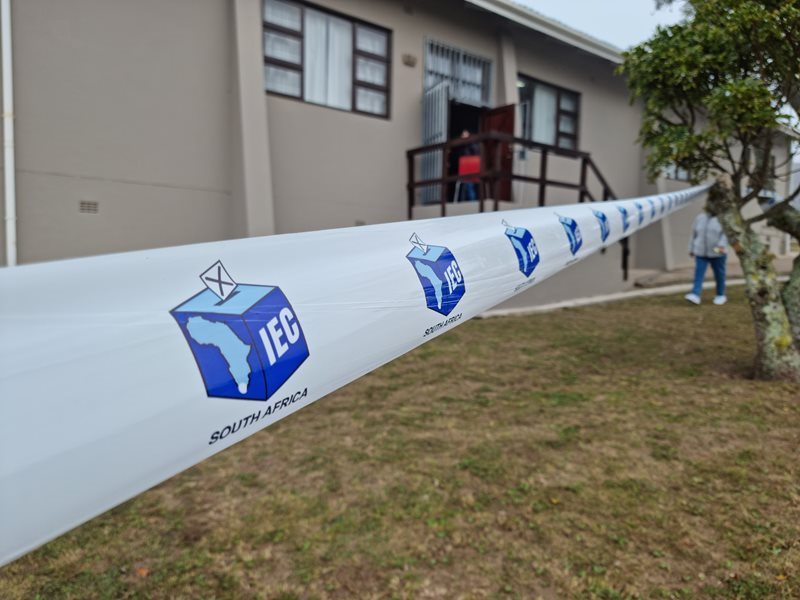
GARDEN ROUTE NEWS - Registered Garden Route voters will head to the polls on Wednesday 4 November to cast their votes in the highly anticipated local government elections (LGEs) taking place across South Africa.
But what happens if you arrive at your voting station and something goes wrong? Here are a few guidelines to ensure the voting process goes smoothly.
What if you arrive at the wrong voting station?
The location of your voting station is generated on the IEC’s website using the home address you provided when registering to vote.
Your voting station is located as close as possible to your home address and will likely be a local church, school or community centre. Voters may only cast their ballots at the voting station where they are registered.
Where buildings are not available, voting stations are set up in tents in parks or other open land. Every voting station has large, clear signs outside marking it as such.
If you arrive at the incorrect voting station on election day, there is no need to panic. Ask the present election officials for assistance and guidance.
You can also re-check your correct voting station and its address at any time by entering your ID number (which you used to register) on the Independent Electoral Commission’s (IEC) website by visiting elections.org.za.
What if your name is missing from the voters’ roll?
Voters had to register with the IEC before the LGEs to have their names placed on the voters’ roll, which closes on election day.
After successfully registering to vote, visit your local IEC office to check if your name is on the voters’ roll before election day.
If you cannot find your name on the roll, you will need to re-register as soon as possible.
This can be done in person while at your local IEC office or online by visiting the IEC’s website.
If you are not on the voters’ roll, but have proof that you have registered (you have a registration sticker, for example), an IEC official must validate your proof of registration.
If satisfied with the proof, you must then complete an MEC7 form for municipal elections and will then proceed as an ordinary voter.
What if your ID is lost, damaged or expired?
When voting, you need to bring a form of identification - a green barcoded ID book, smart ID card, or temporary ID certificate.
Your ID will be used for verification purposes. If your ID is expired, lost or damaged, it is best to have it renewed or receive a temporary ID from the Department of Home Affairs well before election day arrives.
If you are a registered voter, you can vote without an official ID card or book, but you will need to present a valid Temporary Identification Certificate, which is applied for at Home Affairs.
Once you receive a temporary ID, you must bring it with you on election day.
If your ID has not expired, you must bring either the smart ID card or book in its original form.
Passports, driving licences, student cards and photocopies of IDs are not accepted for voting.
What if you make a mistake on your ballot paper?
Once you have checked that you are on the voters’ roll, your ID has been verified, and your thumb has been stamped with black ink, you will receive your ballot papers.
You will then be directed to an empty voting booth, where you will privately vote by clearly marking an X next to your chosen candidates and political parties on your ballot papers.
If you make a mistake and realise it before submitting your ballot papers, ask an election official, and they will provide you with a new ballot paper.
Read your ballot papers carefully before marking an X to avoid a spoilt ballot.
What if you need assistance because of a disability, difficulty reading, or another accessibility need?
Registered voters with a disability, special needs, or who require assistance are provided with a voting aid known as the Universal Ballot Template (UBT) when it is time to vote.
The UBT can be requested from the IEC officials at your voting station and can be used by:
• blind and partially sighted people;
• low-vision users;
• people who are dyslexic;
• the elderly;
• people with low literacy;
• people with motor and nervous conditions that do not allow for a steady hand.
After receiving your ballot papers at your voting station, place the ballot paper in the UBT. Ask the IEC officials for help, who will explain which ballot is used in the template.
They will also ask if you want to know the order in which the names of the parties or candidates appear on the ballot, and may read the parties and candidates aloud.
Voting officials will make sure you clearly understand and will grant you an opportunity to make your mark in private, before helping to submit your folded ballot paper.
What to do if you experience voter intimidation or wish to report a problem at your voting station?
In South Africa, it is a criminal offence:
• to compel or influence an individual to register or not register to vote;
• to compel or influence an individual to vote or not vote;
• to compel or influence an individual to vote for or against any particular party or candidate;
• to compel or influence an individual to support or not support any party or candidate;
• to compel or influence an individual to attend and participate in any political meeting, march, demonstration or other political event; or prevent them from participating in political meetings, marches, demonstrations or other political events.
This also applies when voters are already at the polls on 4 November.
If you as a voter feel that you or someone else is being intimidated or influenced by others present at your voting station, you can lodge a Section 55 Objection through the IEC.
The objection must be lodged before 21:00 on the second day after voting. A Section 55 Objection can be lodged in an email to [email protected] or hand-delivered to Legal Services at the IEC’s Results Operation Centre or Head Office.
‘We bring you the latest Garden Route, Hessequa, Karoo news’