

LOCAL NEWS - Just like the magic drop-goal conversion by Joel Stransky at the end of the match to win the 1995 Rugby World Cup, the rain made a last minute contribution to what was turning out to be a really low November rainfall total.
22 mm fell in Elandskraal during a wonderful thunderstorm event on Friday 28 November, followed by a further 6 mm of drizzle on the Saturday.
This brought the November total rainfall in the middle section of the Karatara River catchment to 58 mm. The November average over 9 years is 67 mm.
The table and comment below includes the December rainfall up until 13 December 2025.
Referring to the table of data:
Overall for the 2025 year, with one month to go, the total is 141 mm less than the nine year average total.
Said another way, we need 141 mm of rain in December to equal the nine year (averaged) total.
Comparing 2025 to the two previous years' total rainfall, with ONE month to go, and not including the 23,5 mm so far up to 13 December, the 2025 total is:
- 317 mm less than the 2024 rainfall total of 808 mm;
- 393 mm less than the 2023 rainfall total of 884 mm.
So we would need those amounts in bold during this December to equal the past two years total rainfall respectively.
The months in 2025 that have received low rainfall are:
- March (45 mm), May (24 mm), July (27 mm), August (7,5 mm), September (20 mm), October (42 mm)
April 2025 (100 mm) was the only really good rain month during 2025. However, most of the rain fell in two main events, 8 - 9 April = 45 mm, and 20 - 21 April = 44 mm.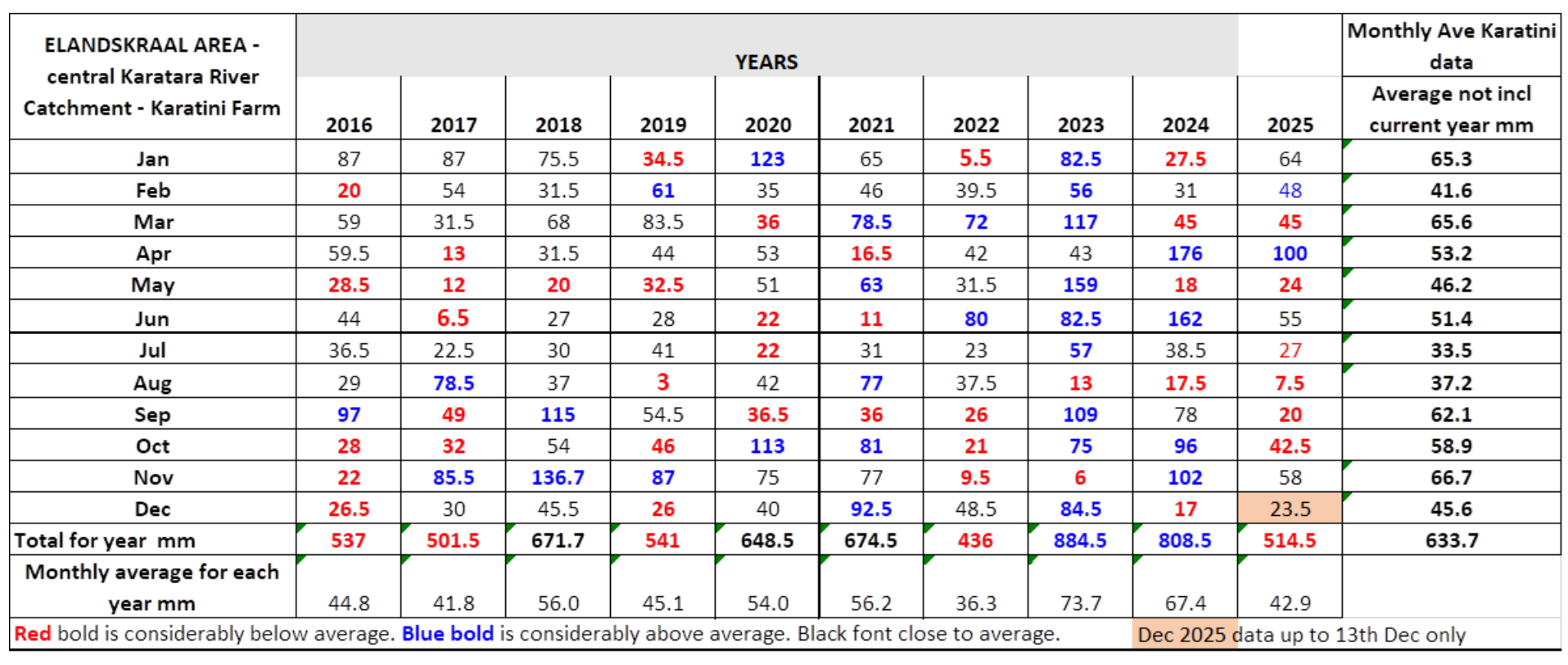 It appears thus that 2025 is going to be a below average rainfall year - unless the rain-gods get excited and deliver a year-end wetting.
Besides the obvious of treating water with the utmost respect, the following is needed: - Less bureaucracy and red tape at local government level so that the technical experts at municipalities and their engineering and science advisors can get the job done - especially when an emergency arises.
- Better long-term planning - not just in terms of water resource provision, but also demand supply management.
- Better maintenance of equipment and infrastructure, plus having backup equipment (pumps) in stock.
- The conjunctive use of various water resources, i.e. surface water, groundwater, treated effluent, is the only way forward given uncertainties with climate change. Best value for money options must be considered, not just in the short-term, but medium to long term.
- Whilst reverse osmosis (desalination) is seen by some to be a solution, it is highly expensive. It does not make economic sense to desalinate highly saline seawater.
- MOST IMPORTANTLY: Active intervention in the catchment areas to eradicate the thirsty alien vegetation which is infesting slopes and the main drainage channels, sucking up water which should be available downstream. The Working on Water programme should never have ceased. It would have yielded benefits now, during the current drought.
It was frustrating to read the article in George Herald on 19 November 2025 : (https://www.georgeherald.com/News/Article/Environment/lack-of-government-funding-for-fighting-invasive-plants-poses-a-challenge-202511191102 ).
Cobus Meiring of the Garden Route Environmental Forum (Gref) noted: “Government grants, including those that previously supported large-scale clearing under programmes such as Working for Water, have shrunk dramatically."
The actions of reduced government funding for alien control in the country’s river catchments is pure folly. It is contrary to the lead heading and message of this article which noted, "Alien plant control must be funded consistently, prioritised strategically and integrated with fire management, biodiversity conservation and climate-adaptation planning."
I couldn’t agree with Gref more.
Investment in catchment alien control/eradication can be partially self-funding.
By not spending on catchment management, Government will end up paying far more - the extra cost which will be passed on to the tax payers.
The cost of the current road tankering of water within Knysna, Brenton on Sea, Buffels Bay, Sedgefield, Wilderness, plus parts of George, must be astronomical.
Its not just the cost of the tanker hire, this is lost revenue as the water supplied by tankers is not paid for by those filling containers. Then there is the passed-on cost to the residents who have to go out and fetch water.
Perhaps the water tankers should decant the water to the municipal reservoirs - unless the pipe and pumping system is the compromising factor.
Investment in catchment alien control is labour intensive - a major opportunity for job creation.
Money spent will go back into the local community, with ultimately taxes back to the Government. Cut trees can be sold as fire-wood, or used for charcoal making and furniture.
 Ritchie Morris
Lets not allow the debate on the importance of water supply to dry up - play your part. Let the rivers flow again.
Ritchie Morris (Pr Sci Nat) is an award-winning hydrogeologist from Karatini Farm, Barrington, Southern Cape.
‘We bring you the latest Garden Route, Hessequa, Karoo news’