

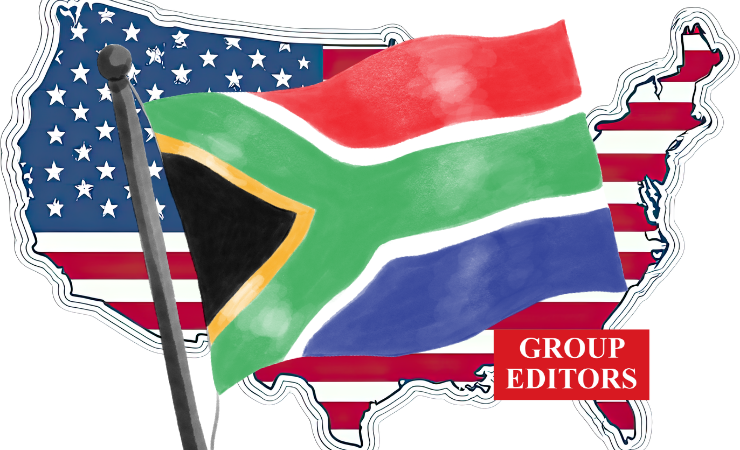
NATIONAL NEWS - South Africa (SA) stands at a crossroads in its relationship with the United States (US), and according to an international relations expert, the government’s current trajectory could cost the country billions in investment, jobs, and credibility.
Tensions between Washington and Pretoria escalated recently after US Secretary of State Marco Rubio announced new visa restrictions targeting foreign nationals accused of involvement in race-based discrimination and uncompensated land seizures in South Africa.
This was followed by further criticism from US ambassador to SA Leo Brent Bozell III, who said the US had “run out of patience” with SA, his démarche, and further US criticism over the action against Bozell III.
In a hard-hitting opinion piece this week, titled The Cost of Doing Nothing, Bozell said the new visa restriction policy Rubio announced on 15 September was a direct consequence of Pretoria’s refusal to engage on issues ranging from farm attacks to foreign investment.
Squandering lifeline
As the SA government stands by its decisions and policies, stressing sovereignty and alleging US interest in SA minerals, Professor André Thomashausen told The Citizen it may be squandering a rare economic lifeline.
“The real risk is that South Africa is losing an enormous opportunity in economic cooperation. If we forego this chance to fix a disastrously failing economy, where half the adult population is unemployed, it will be a great loss and a misdirection of policy.”
Visa restrictions, not sanctions
Shortly after US President Donald Trump took office at the start of 2025, the US pulled aid funding to South Africa, issued an executive order against the country alleging human rights violations, offered refugee status to white “farmers”, and expelled former Ambassador Ebrahim Rasool for his criticism of the Trump administration.
Thomashausen dismissed fears that the US would now impose sweeping sanctions on South Africa amid the impasse.
“Nobody is referring to sanctions on the country, as such. What is being discussed are travel restrictions for certain ANC leaders,” he explained.
He stressed that ordinary South Africans are unlikely to be affected.
“We don’t know how the visa instructions will be applied, but the announcement said they will be applied to officials who are defending hate speech and not prepared to act on it. There’s nothing unusual about this. Every country is free to determine who they allow in,” he explained.
He noted that South Africans should not fear blanket bans, but warned that the broader economic consequences of lost investment could affect everyone.
Billions at stake
“We are already losing billions because companies will not invest in South Africa if over-regulation, dictatorial BEE [Black Economic Empowerment] and EE [Employment Equity] quotas, and policies that don’t exist anywhere else in the world are not removed,” he said.
Farm murders as a flashpoint
Trump has singled out South Africa on several issues since he returned to the White House, notably making debunked claims of white Afrikaners being systematically “killed and slaughtered” in the country.
He ambushed SA President Cyril Ramaphosa in the Oval Office last year, playing a video in which he alleged a campaign against white farmers by the post-apartheid government. The video was later debunked.
Thomashausen pointed to South Africa’s economic challenges and lower real GDP growth rate when compared to many sub-Saharan African regions.
Pretoria has consistently rejected claims of systemic discrimination, with Ramaphosa insisting there is “no evidence of persecution against white people” and warning that narratives of white victimhood threaten post-apartheid unity.
International Relations and Cooperation Minister Ronald Lamola last week told the Council on Foreign Relations event in New York that Americans should know that no white genocide exists.
“It is fake news; it’s not there. There is no evidence to back it.”
Lamola added that even Bozell III knows this and “that is why he cannot confirm it even himself on record.”
“He can just speak with ambiguity because he still has to report to Washington, but the reality is that he knows deep in his heart that it doesn’t exist”.
A failing economy and political reckoning
Thomashausen described South Africa as the worst-performing economy in sub-Saharan Africa, with the lowest GDP growth in the region.
“How do you intend to fix it by continuing with policies that have failed? The ANC is facing a big defeat in the forthcoming local elections, and maybe that is the way for them to reflect on adapting policies that aren’t working,” he said.
He argued that South Africa’s economic malaise of unemployment and municipalities unable to provide safe drinking water makes Washington’s offer of intensified cooperation all the more critical.
“If South Africa foregoes this chance of further developing successful economic relations with the US, where the US is also South Africa’s second-largest trading partner, then that is really a great loss,” he warned.
Minister in the Presidency Khumbudzo Ntshavheni said on Tuesday that the country was a sovereign nation, with the right to decide its own policies for the growth, development, and benefit of all its citizens.
She slammed foreign nations for trying to destabilise the country and domestic critics who, she said, were lobbying against a united South Africa.
“Do not destabilise this country. The destabilisation of this country is not in the best interest of any of us. It is not in the interest of any political party, or any special grouping. It is a united and a prosperous SA that benefits all of us,” she said.
Diplomatic engagement, not defiance
Asked whether South Africa should seek a diplomatic resolution, Thomashausen was blunt.
“It’s not a matter of diplomatic resolution. It’s a matter of diplomatic engagement. The United States don’t need South Africa for anything. For them to continue to offer intensifying economic cooperation is a great outlook for South Africa,” he said.
He criticised the ANC government for clinging to ideological positions that alienate Washington while failing to deliver tangible benefits at home.
“South Africa is not getting the same kind of offers from its favourite international partner, Iran. Iran is not even giving South Africa a discount on oil and diesel. So, it’s bizarre that the ANC is digging their heels in over something that cannot fix the problems of South Africa,” he said.
Final warning
Thomashausen urged the South African government to adopt a mature foreign policy guided by rational analysis rather than emotion.
“Diplomacy is the art of understanding and respecting each other equally, not offending and insulting people. A mature foreign policy will try to resolve differences like any adults. The current Dirco [Department of International Relations and Cooperation] line is not constructive, and it is not succeeding,” he concluded.
Article: Caxton publication, The Citizen
‘We bring you the latest Garden Route, Hessequa, Karoo news’