

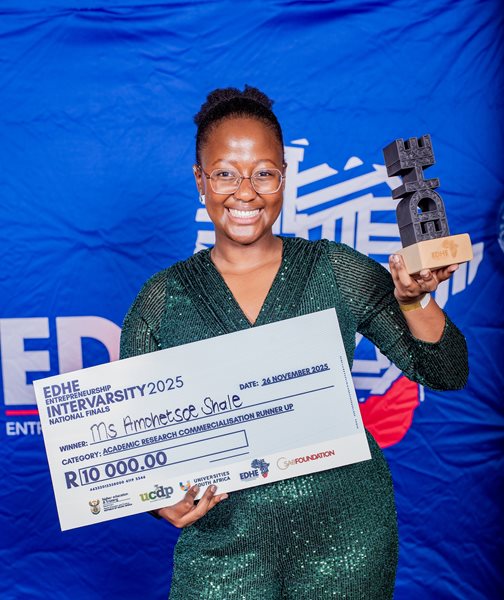
ENTERTAINMENT NEWS - When the talented and inspirational Amohetsoe Shale took to the stage as the winner of this year’s Top Student Womanpreneur at the seventh annual EDHE Entrepreneurship Intervarsity, it was hardly surprising that Alicia Keys’ anthem for empowerment Girl on Fire blasted loudly through the auditorium.
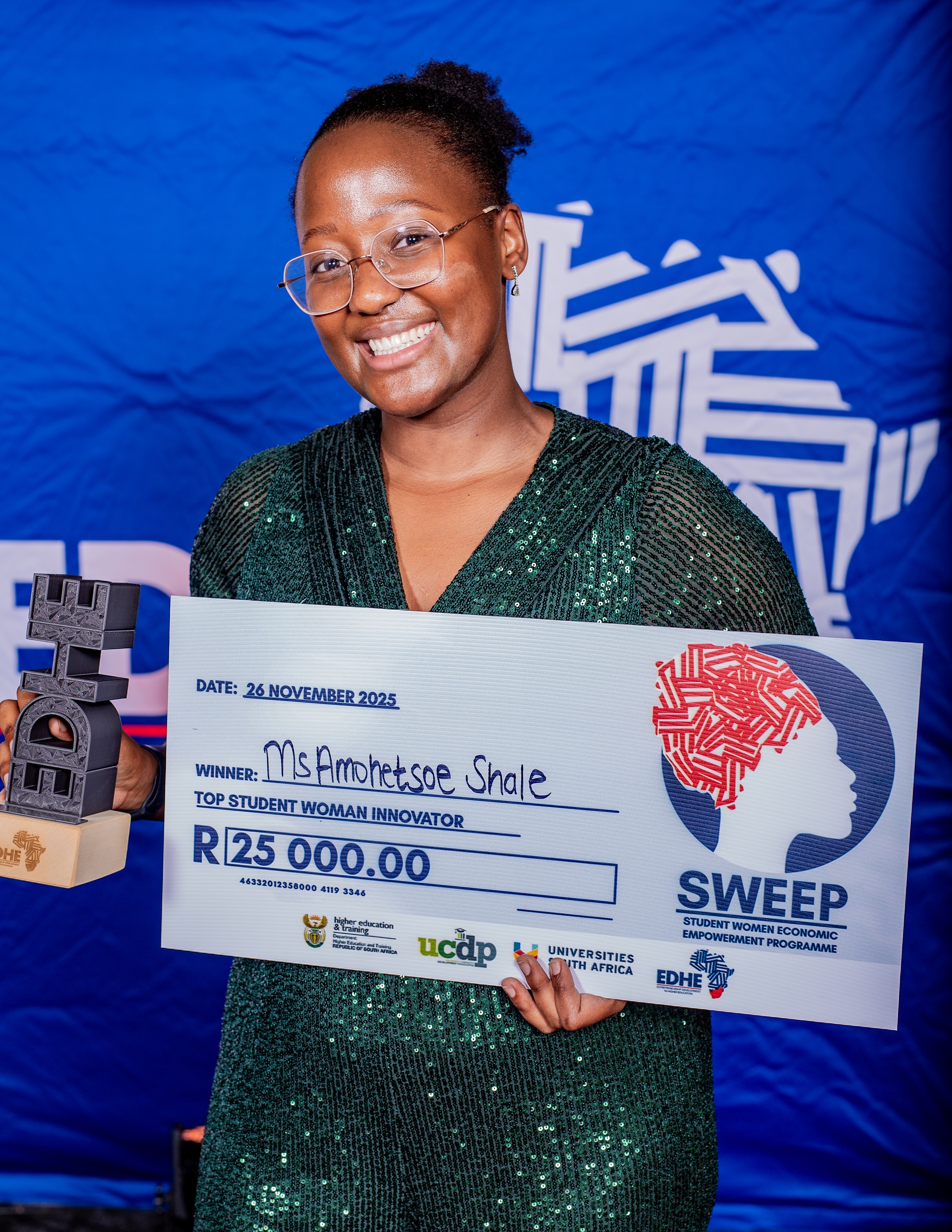
The Stellenbosch University student – and founder and CEO of the NAVU company, who designs affordable, high-performing prosthetic knees for amputees – won R25 000 and the title.
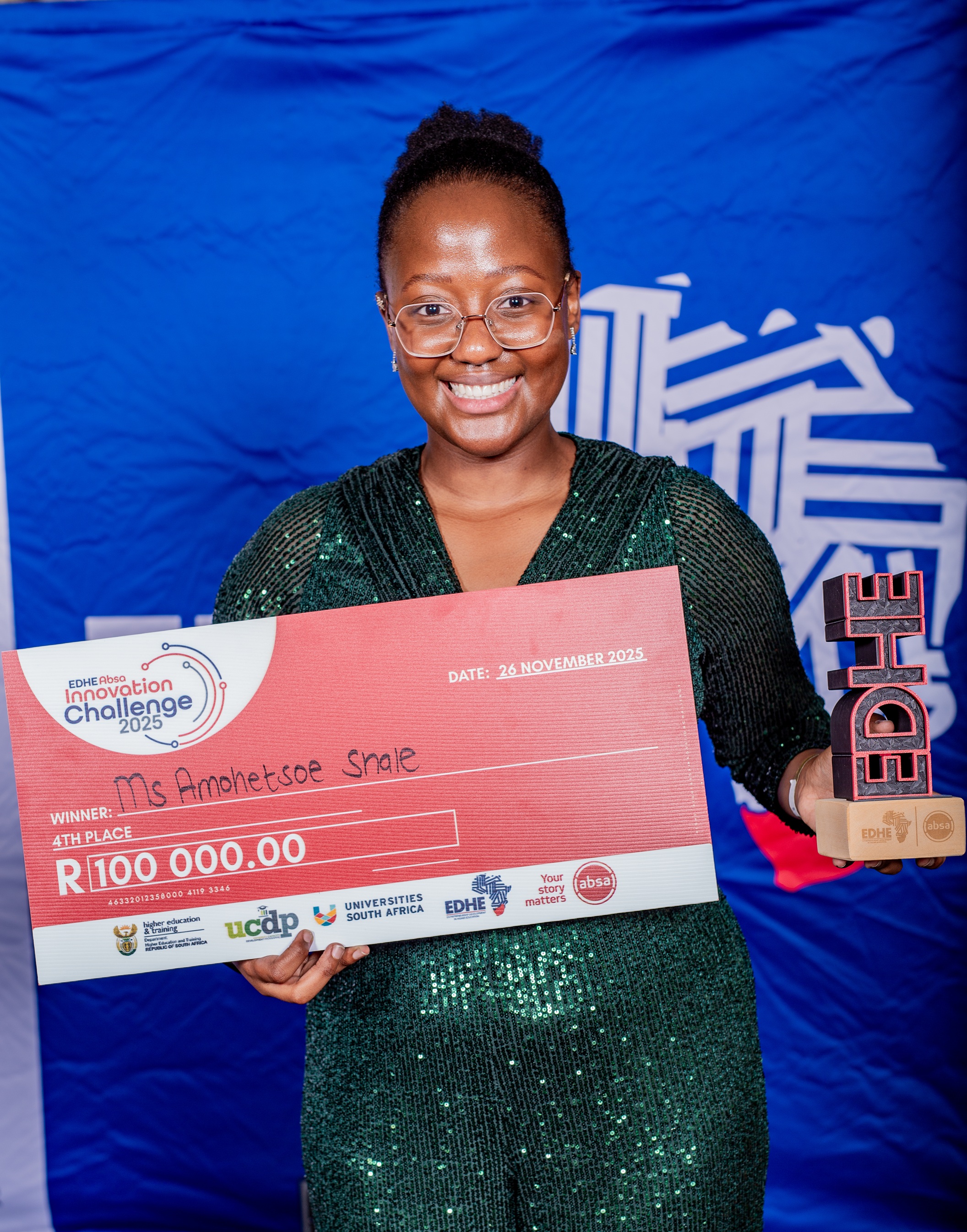
However, this wasn’t her only victory at the ceremony – she was also runner-up in the Academic Research Commercialisation category (winning R10 000) and took fourth place in the EDHE Absa Top Student Innovator of the Year at the EDHE Absa Innovation Challenge, where she won R100 000.
Her total prize money was R135 000.
EDHE – a programme that aims to develop the entrepreneurial capacity of university students, academics and university leaders – is a collaboration between Universities South Africa (USAf) and the Department of Higher Education and Training (DHET). It works to help students become more economically active by providing support, running competitions such as the EDHE Absa Innovation Challenge and EDHE Entrepreneurship Intervarsity while offering programmes and initiatives to foster entrepreneurial skills.
Shale is a full-time MEng Sc Biomedical Engineering student at Stellenbosch University (SU). She graduated with a BHSc in Medical Orthotics and Prosthetics (cum laude) at Walter Sisulu University (WSU) in the Eastern Cape.
Her winning innovation is an affordable, high-performing passive polycentric prosthetic knee, a device which uses a four-bar (polycentric) linkage to provide a stable, natural gait for transfemoral amputees.
Shale and her team have also cleverly integrated off-the-shelf components, such as MTB bike shocks, to offer shock absorption and energy return at a fraction of the usual cost.
She explains: “The knee has been developed using Design for Manufacturing (DFM) principles to ensure it can be produced using low-cost manufacturing processes. It is also fully modular, making local repairs and adjustments easier for clinicians. Its key features include durability, ease of fitting and maintenance with reliable performance across uneven terrain and in the daily activities common within amputee user communities.”
NAVU is one of the very few – if not the only – team designing and commercialising a passive polycentric prosthetic knee in South Africa. Ultimately, the goal is to bridge the gap between high-cost commercial components and the real, urgent needs of clinics and amputees in underserved settings.
The idea for the prosthetic was born during Shale’s undergraduate studies in Medical Orthotics and Prosthetics, where she spent significant time working directly with amputees in clinical settings. She was alarmed by the quality of prosthetic knees available to many transfemoral (above-knee) amputees, especially in low-resource environments.
Says Shale: “The knee is one of the most complex joints in the body. It’s not just a hinge; it rotates around shifting centres, absorbs shock, stabilises the body, and largely determines the quality of mobility an amputee can achieve. Yet many patients were being fitted with the absolute bare minimum, devices that often made walking difficult, unsafe, or painful. Research consistently shows that the type of prosthetic knee dramatically influences gait quality and functional independence. I saw that play out in real life far too often.
“What troubled me most was knowing that advanced prosthetic technology does exist in South Africa, but many patients would never access it simply because they cannot afford it. As a society, we should never accept that something as fundamental as mobility, the basic ability to walk, depends on how wealthy someone is. But that is the reality in South Africa.
“I reached a point where I realised I couldn’t just observe this problem; I needed to contribute to a solution. I began exploring the concept during my final undergraduate year as a simple proof of concept. Now, during my postgraduate studies, I am refining and improving the design to develop a prosthetic knee that meets clinical needs while remaining truly affordable.”
Shale says she is deeply humbled by the recognition that she has received: “This affirms the hard work of the entire NAVU team and our collaborators. Winning in multiple categories was a powerful reminder that the problem we’re solving truly matters. I don’t take these honours lightly. In a country where women still face so many barriers, I am incredibly proud to stand among a generation of females who persevere, innovate and push forward despite adversity. It felt like a celebration -- not just of my work -- but of the resilience and brilliance of women across South Africa.
‘Representation truly matters’
Both awards were a triumph for female innovators, which delighted Shale.
“They highlight the growing visibility, influence and excellence of women in engineering, health technology and entrepreneurship. Representation truly matters! When young women see other women succeeding, it expands the boundaries of what they believe is possible for themselves.
“Toni Morrison once said, ‘If you have some power, then it is your job to empower somebody else’. As women beginning to find our footing in male-dominated spaces, we have a responsibility to open doors for those coming after us. Our role is not only to excel individually but to mentor, connect and support other women so that the path becomes wider and more accessible.”
Shale says her prize money will be used to accelerate prototype refinement and bench testing. This includes paying for iterative manufacturing runs and small-scale user trials to collect performance and usability data. Where possible, she and her team will also invest in protecting intellectual property and preparing documentation needed for regulatory steps and pilot manufacturing.
“We will then complete bench testing and prepare for user evaluations. We will be formalising partnerships with rehabilitation clinics for pilot fittings and begin preparations for regulatory submissions and small-batch manufacturing.
“Parallel to technical development, we are pursuing collaborations with non-governmental organisations and healthcare providers to plan distribution and training for local prosthetic technicians.
“In five years, I hope NAVU is operating regional production or assembly facilities and supplying affordable, clinically validated prosthetic knees to clinics across multiple countries in sub-Saharan Africa. I want NAVU to be a recognised partner to public and private health systems and to have trained a network of local technicians and clinicians who can independently fit and maintain our devices. I want to be at the forefront of that work, driving the engineering, building partnerships, and staying grounded in the realities of amputees and clinicians so our solutions remain meaningful.”
She says her vision, ultimately, is also cultural.
“I want young African amputees to see themselves represented — to see other African amputees wearing NAVU prosthetics on billboards, in workplaces, in sport, and in everyday life. The lack of access to mobility is not just a product challenge but a systemic one, and over the next few years, we will dismantle those barriers, piece by piece. Amputees deserve visibility, dignity and opportunity, and I want to be part of reshaping that reality.”
She believes competitions such as these held by EDHE are vital.
“They provide much-needed validation for student entrepreneurs who often struggle to take up space in an industry that still tends to reward age and established networks over ingenuity. They create opportunities for focused feedback, visibility and exposure to potential partners, mentors, and funders. This competition, specifically, pushed me to sharpen my value proposition, practise pitching under pressure, and engage with people who can help move prototypes from the lab into the hands of real users, and that has been an invaluable advantage. For early-stage ventures, these competitions act as a practical bridge between having a promising idea and accessing the resources, networks, and credibility needed to scale.”
As she left the stage, it was hard to believe that Keys hadn’t penned the lyrics of her song, especially for this dynamic young woman determined to make the lives of others better.
“Looks like a girl, but she's a flame
So bright, she can burn your eyes
Better look the other way
You can try, but you'll never forget her name
She's on top of the world
This girl is on fire…”
Article: Janine Greenleaf Walker is a contract writer for Universities South Africa.
‘We bring you the latest Garden Route, Hessequa, Karoo news’